Back
The MetaWardrobe
The MetaWardrobe (Web3/AR)
A web3 digital wardrobe for clothes NFT collections.

About the project
The MetaWardrobe is a web3 project conceived by MetaKosmos, an agency specialized in XR/AR/VR and web3 experiences.
Excited by the potential of the clothes segment in e-commerce, MetaKosmos wanted to create an immersive experience that would allow users to experiment clothes in a virtual clothing fitting room and have their own digital wardrobe with NFTs.
Discovery + Framing
The first step was to understand the project objective. From initial talks with the Metakosmos CEO, it was clear that the MetaWardrobe is an experiment, a MVP that needs user validation to later seek investments and setup an early-stage startup.
The MetaKosmos team did a market research, including data from brazilian e-commerce stores, investors and foresights. I received all data and analysed what would be the requisites and restraints for implementation in the brazilian retail market.
Benchmark


Main solutions mapped were 3DLOOK Your Fit, GoodStyle, Wanna and DRESSX. DRESSX stood out for its ability of clothes selection and interaction features.
Key Takeaways of Discovery
Fashion retail is evolving and considering immersion features to boost fidelity and sales.
There are opportunities for brands to use NFTs and user interaction both for loyalty and marketing.
Brazilian investors and cloth brands were optimistic and provided suggestions.
Users usually map a considerable amount of SKUs before a final purchase.
There are two main problems to solve in fashion: 1. Am I feeling beautiful?; and 2. What will others think of me?
Brazilians spend in average 13 hours a day connected, with massive adoption of social networks, games and metaverses.
The fashion solutions are a target since we tend to give more importance to our virtual identities.
Framing
As a result of the research phase, an user journey with key actions and moment highlights was setup for overall experience visibility. This exercise allowed us to map key pain points and opportunities in the service adoption.

Next step consisted in a collaborative discussion panel with the MetaKosmos team to discuss experience steps, barriers, opportunities and what moment of the journey we should tackle with the new MetaWardrobe solution.
It was clear for the team that we should aim to boost sales and act in a moment where users are actively looking for something to buy.
Key Takeaways of Framing
The product journey would start inside stores, once users are already actively looking for something to buy;
Users should be able to customize their looks;
Users should be able to freely experiment and share their looks to boost store visibility;
Fashion is now phygital: users can buy clothes and have a digital collectible version;
Collectibles are NFTs and will serve as tools of engagement between users and brands;
There would be a need of multiple solutions to cover the store immersion and the NFTs collections.
Creation and Prototyping
Once the problem was framed and we had a clear vision of what we sought, I got together with the CEO and the product team of Metakosmos to ideate possibilities for a positive user experience in the initial sales moment.

First sketches done in collaboration with the product manager gave us an idea of ecosystem that would serve both the users and the online stores.
As a result of that session, we consented that the solution would require more than one feature, because it would not only cover the NFT wardrobe for stores fidelity programs, but we should let users experiment and share their experiments in social media. That would give another advantage to the MetaWardrobe solution, since it would become a powerful marketing tool for clothing brands.

Information Architecture
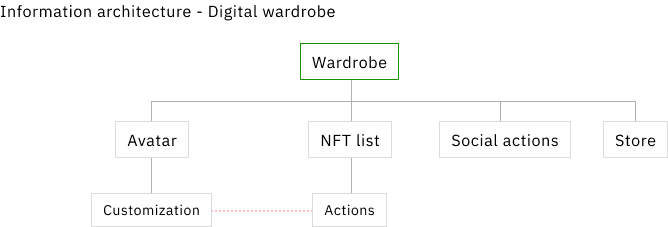
The information architecture was built considering the features for each channel. The app would prioritize experimentation and purchases, while the wardrobe would store the NFTs and give access to benefits information.

Prototype
Based on the initial ideation sketches, I started to explore possibilities considering the information architecture for the fashion playground, the e-commerce plugin and the NFT wardrobe.

Flow 1: Experimenting clothes with AR
The first solution would consider AR and simulate clothes on users, letting them choose size, colors, background music and filter effects. The effects would inspire users to share their experiments on social media.


Flow 2: E-commerce plugin and fashion playground
The second solution would be an e-commerce plugin and the fashion playground to be implemented in the online stores. Users would be able to edit their own avatar, picking a scenario, music, clothing size, colors, share their avatar on social media, add clothes to the cart or buy their looks. The solution would be phygital, since users can buy the physical clothing and receive a digital copy as a NFT.


Users would be able to purchase their looks, both in physical and digital version.

The e-commerce plugin would be a fast way to play, experiment and buy while navigating the online store.
Flow 3: NFT wardrobe
The third solution would be a digital wardrobe for users to keep their NFTs, share their avatars on games / social media and get benefits from stores fidelity programs.

The digital wardrobe would let users store their NFT clothes, edit their own avatar, use the avatar in games and other interactive universes.
Testing
To evaluate the proposition, I executed internal usability tests, similar to a guerrilla test.
The evaluation was composed of 3 phases:
Moderated usability tests to evaluate the UI design and navigation;
Interview to evaluate the perceived value, sense of utility and desirability;
During the interviews, users questioned the possibility of creating their own avatars. This feedback was considered relevant and we took as a chance to improve the product.
A new optional flow was created for the virtual dressing room. Now users would be able to create, edit and save their own avatar.


The iteration considered a new flow for the virtual dressing room: users now could create their own avatar with height, weight, body style and even use their own face.
Key Takeaways of Prototyping and Testing
No major usability issues were found in the moderated tests;
One minor usability issue was found in the usage of the e-commerce plugin and fixed;
Users questioned the possibility of creating their own avatar and this feedback was taken into consideration for a product iteration.
Results and learnings
The MetaWardrobe ecosystem was presented to the CEO of MetaKosmos in every phase and to investors with the test results when finalized. The proposal was approved, including the avatar creation iteration, then delivered for development and implementation on retail brands.
Redley: +56% conversion
Boca Rosa: +315% conversion
Other placements: General Motors (FOOH Viral), Serasa Experian (AR Filter), Convida (Virtual Tour 3D), Mercado Pago (AR Filter)
Learnings
This project challenged me to come up with a solution that included both e-commerce stores and their respective clients. It also challenged me to consider multiple solutions that were part of one larger experience ecosystem.
It helped me to better understand fashion stores and their demands;
It helped me to better understand brazilian e-commerces restrictions and possibilities.